Animals Zoo Park - Amazing - Funny - Dangerous Animals

African Animals, Asian Animals, Amazing Photos, Amazing Under Water Photos Birds Photos, Flowers Pics, Free Wallpapers, Funny People Pics, Funny Pictures, Funny Videos, Hunting Videos Hunting Pics, Soccer Wallpapers, Tennis Pictures 7 Natural Wonders Information, 7 Under Water Wonders Information, 7 Wonders of the Medieval Mind, 7 Wonders of the Modern World, 7 Wonders of the Ancient World, Wonderful Temple Wallpaper, Top 10 Hollywood Stars (By visitors request), Top 10 soccer Players (By visitors request), Top 10 Tennis Players (By visitors request), 10 most Dangerous Snakes, Dangerous Animals, 10 most deadliest snakes, 10 Most Poisonous Animals in the World, all Wonders Of the World.
Showing posts with label The Wonders of the Ancient World. Show all posts

Thursday, January 28, 2010

Hanging Gardens of Babylon Pics and Pictures, Hanging Gardens of Babylon Info - The Wonders of the Ancient World

The Wonders of the Ancient World Pictures and Gallery Photos : Hanging Gardens of Babylon Pictures and Info

Hanging Gardens of Babylon PictureHanging Gardens of Babylon Picture


The Hanging Gardens of Babylon PicsThe Hanging Gardens of Babylon Pics

Hanging Gardens of Babylon PictureHanging Gardens of Babylon Picture

The Hanging Gardens of Babylon PicsThe Hanging Gardens of Babylon Pics


About Hanging Gardens of Babylon :

The Hanging Gardens of Babylon (also known as the Hanging Gardens of Semiramis) and the walls of Babylon (present-day Iraq) were considered one of the Seven Wonders of the World. They were both supposedly built by Nebuchadnezzar II around 600 BC.


The Hanging Gardens are extensively documented by Greek historians such as Strabo and Diodorus Siculus, but otherwise there is little evidence for their existence. In fact, there are no Babylonian records of any such gardens having existed. Some (circumstantial) evidence gathered at the excavation of the palace at Babylon has accrued, but does not completely substantiate what look like fanciful descriptions.

Some schools of thought think that through the ages the location may have been confused with gardens that existed at Nineveh as tablets from there clearly showing gardens have been found. Writings on these tablets describe the possible use of something similar to an Archimedes' screw as a process of raising the water to the required height.

According to accounts, the gardens were built to cheer up Nebuchadnezzar's homesick wife, Amyitis. Amyitis, daughter of the king of the Medes, was married to Nebuchadnezzar to create an alliance between the nations. The land she came from, though, was green, rugged and mountainous, and she found the flat, sun-baked terrain of the Mesopotamia (a region of southwest Asia) depressing. The king decided to recreate her homeland by building an artificial mountain with rooftop gardens.

The Hanging Gardens probably did not really "hang" in the sense of being suspended from cables or ropes. The name comes from an inexact translation of the Greek word kremastos or the Latin word pensilis, which means not just "hanging² but "overhanging," as in the case of a terrace or balcony.

The Greek geographer Strabo, who described the gardens in the first century BC, wrote, "It consists of vaulted terraces raised one above another, and resting upon cube-shaped pillars. These are hollow and filled with earth to allow trees of the largest size to be planted. The pillars, vaults, and terraces are constructed of baked brick and asphalt."

More recent archaeological excavations at the ancient city of Babylon in Iraq uncovered the foundation of the palace. Other findings include the Vaulted Building with thick walls and an irrigation well near the southern palace. A group of archaeologists surveyed the area of the southern palace and reconstructed the Vaulted Building as the Hanging Gardens.

However, the Greek historian Strabo had stated that the gardens were situated by the River Euphrates. So others argue that the site is too far from the Euphrates to support the theory since the Vaulted Building is several hundreds of meters away.

They reconstructed the site of the palace and located the Gardens in the area stretching from the River to the Palace. On the river banks, recently discovered massive walls 25 m thick may have been stepped to form terraces... the ones described in Greek references.

Temple of Artemis at Ephesus Photos info - The Wonders of the Ancient World

The Wonders of the Ancient World : Temple of Artemis at Ephesus info Photos

The Temple of Artemis at Ephesus PhotoThe Temple of Artemis at Ephesus Photo

The Temple of Artemis at Ephesus PhotoThe Temple of Artemis at Ephesus Photo

The Temple of Artemis at Ephesus PhotoThe Temple of Artemis at Ephesus Photo

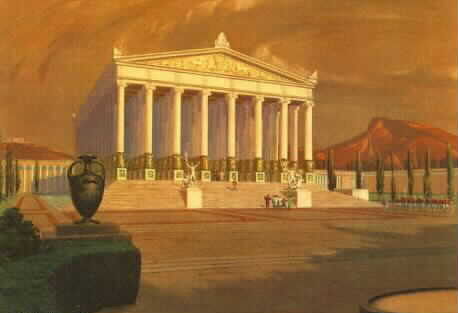
Is it simply a temple? How could it take its place among other unique structures such as the Pyramid, the Hanging Gardens, and the Colossus of Rhodes? For the people who actually visited it, the answer was simple. It was not just a temple... It was the most beautiful structure on earth... It was built in honor of the Greek goddess of hunting and wild nature. That was the Temple of Artemis (Diana) at Ephesus.

Temple of Artemis Location: The ancient city of Ephesus near the modern town of Selcuk, about 50 km south of Izmir in Turkey.

Temple of Artemis at Ephesus Description: Rectangular in shape, the temple was 170ft wide and 366ft long. The temple had 127 columns, (each was 66 feet tall) those at the front were decorated with intricate sculptures. The entire structure was erected from marble, an unusual material for building temples. A statue of Artemis stood in the middle of the temple.

Temple of Artemis at Ephesus Information: Following his conquest of the Greek city of Ephesus, King Croesus built a temple to honor the goddess of hunting/wind nature, Artemis. The temple was built in 550BC, and was designed by the Greek architect Chersiphron. It was built by colonists of the town, Ephesus. Inside the temple was an inner room called the sanctuary that housed a magnificent statue of the goddess. The temple became very famous and attracted visitors far and wide. Its purposes included both a marketplace and religious institution.

On the night of July 21, 356 BC, a man named Herostratus set fire to the temple in an attempt to immortalize his name. The roof caved in, the columns collapsed, and the statue of the goddess crashed to the ground. Over the next two decades, the temple was restored, with the additional help of Alexander the Great when he successfully conquered Asia Minor.

Then in 262 AD, the temple was destroyed again and the residents of Ephesus vowed to rebuild the it. During this time, the temple began to lose its importance, as many began switching to Christianity, the town was later deserted. The temple was plundered by Goths and later swamped by floods. In recent years, archaeologists have discovered and excavated the town. Attempts have been made to reconstruct the temple, but so so far only a couple columns have been erected upon the remaining foundation..

The Mausoleum at Halicarnassus Pictures - Info, The Wonders of the Ancient World

The Wonders of the Ancient World : The Mausoleum at Halicarnassus Info Photos and Pictures.

The Mausoleum at Halicarnassus PicsThe Mausoleum at Halicarnassus Pics

The Mausoleum at Halicarnassus PictureThe Mausoleum at Halicarnassus Picture

The Mausoleum at Halicarnassus PhotoThe Mausoleum at Halicarnassus Photo

The Mausoleum at Halicarnassus PictureThe Mausoleum at Halicarnassus Picture


Similar to the Great Pyramid, we are now visiting the burial place of an ancient king. Yet the Mausoleum is different - so different from the Pyramid that it earned its reputation - and a spot within the list - for other reasons. Geographically, it is closer to the Temple of Artemis... And it was the beauty of the tomb rather than its size that fascinated its visitors for years.

The Mausoleum Location : In the city of Bodrum (f.k.a. Halicarnassus) on the Aegean Sea, in south-west Turkey.

The Mausoleum at Halicarnassus History : When the Persians expanded their ancient kingdom to include Mesopotamia, Northern India, Syria, Egypt, and Asia Minor, the king could not control his vast empire without the help of local governors or rulers -- the Satraps. Like many other provinces, the kingdom of Caria in the western part of Asia Minor (Turkey) was so far from the Persian capital that it was practically autonomous. From 377 to 353 BC, king Mausollos of Caria reigned and moved his capital to Halicarnassus. Nothing is exciting about Maussollos life except the construction of his tomb. The project was conceived by his wife and sister Artemisia, and the construction might have started during the king's lifetime. The Mausoleum was completed around 350 BC, three years after Maussollos death, and one year after Artemisia's.

For 16 centuries, the Mausoleum remained in good condition until an earthquake caused some damage to the roof and colonnade. In the early fifteenth century, the Knights of St John of Malta invaded the region and built a massive crusader castle. When they decided to fortify it in 1494, they used the stones of the Mausoleum. By 1522, almost every block of the Mausoleum had been disassembled and used for construction.

Today, the massive castle still stands in Bodrum, and the polished stone and marble blocks of the Mausoleum can be spotted within the walls of the structure. Some of the sculptures survived and are today on display at the British Museum in London. These include fragment of statues and many slabs of the frieze showing the battle between the Greeks and the Amazons. At the site of the Mausoleum itself, only the foundation remains of the once magnificent Wonder.

The Mausoleum at Halicarnassus Description : The structure was rectangular in plan, with base dimensions of about 40 m (120 ft) by 30 m (100 ft). Overlying the foundation was a stepped podium which sides were decorated with statues. The burial chamber and the sarcophagus of white alabaster decorated with gold were located on the podium and surrounded by Ionic columns. The colonnade supported a pyramid roof which was in turn decorated with statues. A statue of a chariot pulled by four horses adorned the top of the tomb.

The total height of the Mausoleum was 45 m (140 ft). This is broken down into 20 m (60 ft) for the stepped podium, 12 m (38 ft) for the colonnade, 7 m (22 ft) for the pyramid, and 6 m (20 ft) for the chariot statue at the top.

The beauty of the Mausoleum is not only in the structure itself, but in the decorations and statues that adorned the outside at different levels on the podium and the roof. These were tens of life-size as well as under and over life-size free-standing statues of people, lions, horses, and other animals. The statues were carved by four Greek sculptors: Bryaxis, Leochares, Scopas, and Timotheus, each responsible for one side. Because the statues were of people and animals, the Mausoleum holds a special place in histroy as it was not dedicated to the gods of Ancient Greece.

Since the nineteenth century, archeological excavations have been undertaken at the Mausoleum site. These excavations together with detailed descriptions by ancient historians give us a fairly good idea about the shape and appearance of the Mausoleum. A modern reconstruction of the shorter side of the Mausoleum illustrates the lavish nature of the art and architecture of the building... a building for a King whose name is celebrated in all large tombs today -- mausoleums.

The Colossus of Rhodes Greece Pics Info

About The Colossus of Rhodes in Greece - The Wonders of the Ancient World Info Photos and Pics

The Colossus of Rhodes PictureThe Colossus of Rhodes Picture

The Colossus of RhodesThe Colossus of Rhodes

The Colossus of Rhodes

The Colossus of Rhodes PicsThe Colossus of Rhodes Pics


From its building to its destruction lies a time span of merely 56 years. Yet the colossus earned a place in the famous list of Wonders. "But even lying on the ground, it is a marvel", said Pliny the Elder. The Colossus of Rhodes was not only a gigantic statue. It was rather a symbol of unity of the people who inhabited that beautiful Mediterranean island -- Rhodes.

The Colossus of Rhodes Location :

At the entrance of the harbor of the Mediterranean island of Rhodes in Greece.

The Colossus of Rhodes in Greece History :

Throughout most of its history, ancient Greece was comprised of city-states which had limited power beyond their boundary. On the small island of Rhodes were three of these: Ialysos, Kamiros, and Lindos. In 408 BC, the cities united to form one territory, with a unified capital, Rhodes. The city thrived commercially and had strong economic ties with their main ally, Ptolemy I Soter of Egypt. In 305 BC, the Antigonids of Macedonia who were also rivals of the Ptolemies, besieged Rhodes in an attempt to break the Rhodo-Egyptian alliance. They could never penetrate the city. When a peace agreement was reached in 304 BC, the Antagonids lifted the siege, leaving a wealth of military equipment behind. To celebrate their unity, the Rhodians sold the equipment and used the money to erect an enormous statue of their sun god, Helios.

The construction of the Colossus took 12 years and was finished in 282 BC. For years, the statue stood at the harbor entrance, until a strong earthquake hit Rhodes about 226 BC. The city was badly damaged, and the Colossus was broken at its weakest point -- the knee. The Rhodians received an immediate offer from Ptolemy III Eurgetes of Egypt to cover all restoration costs for the toppled monument. However, an oracle was consulted and forbade the re-erection. Ptolemy's offer was declined.

For almost a millennium, the statue laid broken in ruins. In AD 654, the Arabs invaded Rhodes. They disassembled the remains of the broken Colossus and sold them to a Jew from Syria. It is said that the fragments had to be transported to Syria on the backs of 900 camels.

The Colossus of Rhodes in Greece Description :

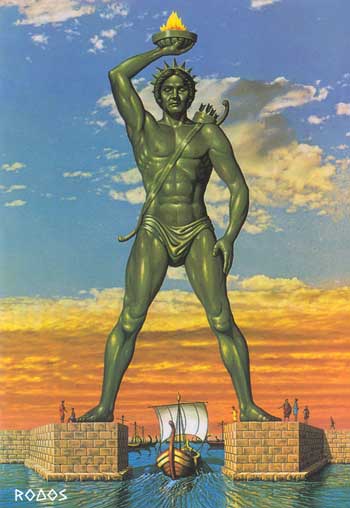
Let us first clear a misconception about the appearance of the Colossus. It has long been believed that the Colossus stood in front of the Mandraki harbor, one of many in the city of Rhodes, straddling its entrance. Given the height of the statue and the width of the harbor mouth, this picture is rather impossible than improbable. Moreover, the fallen Colossus would have blocked the harbor entrance. Recent studies suggest that it was erected either on the eastern promontory of the Mandraki harbor, or even further inland. Anyway, it did never straddle the harbor entrance.

The project was commissioned by the Rhodian sculptor Chares of Lindos. To build the statue, his workers cast the outer bronze skin parts. The base was made of white marble, and the feet and ankle of the statue were first fixed. The structure was gradually erected as the bronze form was fortified with an iron and stone framework. To reach the higher parts, an earth ramp was built around the statue and was later removed. When the colossus was finished, it stood about 33 m (110 ft) high. And when it fell, "few people can make their arms meet round the thumb", wrote Pliny.

Although we do not know the true shape and appearance of the Colossus, modern reconstructions with the statue standing upright are more accurate than older drawings. Although it disappeared from existence, the ancient World Wonder inspired modern artists such as French sculptor Auguste Bartholdi best known by his famous work: The Statue of Liberty.

Tuesday, January 26, 2010

The Lighthouse of Alexandria Pics Information

The Wonders of the Ancient World : Information About the The Lighthouse of Alexandria with Photos and Video Pics

The Lighthouse of Alexandria PhotoThe Lighthouse of Alexandria Photo

The Lighthouse of Alexandria PicsThe Lighthouse of Alexandria Pics

The Lighthouse of AlexandriaThe Lighthouse of Alexandria


Information About the The Lighthouse of Alexandria : One Of the Seven Wonders of the Ancient World, only one had a practical use in addition to its architectural elegance: The Lighthouse of Alexandria. For sailors, it ensured a safe return to the Great Harbor. For architects, it meant even more: it was the tallest building on Earth. And for scientists, it was the mysterious mirror that fascinated them most... The mirror's reflection could be seen more than 50 km (35 miles) off-shore.

Light House of Alexandria Location :
On the ancient island of Pharos, now a promontory within the city of Alexandria in Egypt.

Light House of Alexandria History :
Shortly after the death of Alexander the Great, his commander Ptolemy Soter assumed power in Egypt. He had witnessed the founding of Alexandria, and established his capital there. Off of the city's coast lies a small island: Pharos. Its name, legend says, is a variation of Pharaoh's Island. The island was connected to the mainland by means of a dike - the Heptastadion - which gave the city a double harbor. And because of dangerous sailing conditions and flat coastline in the region, the construction of a lighthouse was necessary.

The project was conceived and initiated by Ptolemy Soter around 290 BC, but was completed after his death, during the reign of his son Ptolemy Philadelphus. Sostratus, a contemporary of Euclid, was the architect, but detailed calculations for the structure and its accessories were carried out at the Alexandria Library/Mouseion. The monument was dedicated to the Savior Gods: Ptolemy Soter (lit. savior) and his wife Berenice. For centuries, the Lighthouse of Alexandria (occasionally referred to as the Pharos Lighthouse) was used to mark the harbor, using fire at night and reflecting sun rays during the day. It was even shown on Roman coins, just as famous monuments are depicted on currency today.

When the Arabs conquered Egypt, they admired Alexandria and its wealth. The Lighthouse continues to be mentioned in their writings and travelers accounts. But the new rulers moved their capital to Cairo since they had no ties to the Mediterranean. When the mirror was brought down mistakenly, they did not restore it back into place. In AD 956, an earthquake shook Alexandria, and caused little damage to the Lighthouse. It was later in 1303 and in 1323 that two stronger earthquakes left a significant impression on the structure. When the famous Arab traveler Ibn Battuta visited Alexandria in 1349, he could not enter the ruinous monument or even climb to its doorway.

The final chapter in the history of the Lighthouse came in AD 1480 when the Egyptian Mamelouk Sultan, Qaitbay, decided to fortify Alexandria's defense. He built a medieval fort on the same spot where the Lighthouse once stood, using the fallen stone and marble.

The Light House of Alexandria Description :
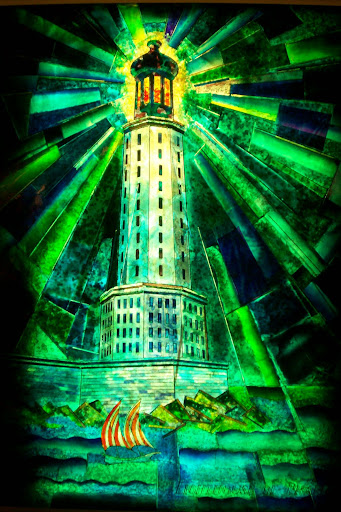
Of the six vanished Wonders, the Lighthouse of Alexandria was the last to disappear. Therefore we have adequately accurate knowledge of its location and appearance. Ancient accounts such as those by Strabo and Pliny the Elder give us a brief description of the "tower" and the magnificent white marble cover. They tell us how the mysterious mirror could reflect the light tens of kilometers away. Legend says the mirror was also used to detect and burn enemy ships before they could reach the shore.

In 1166, an Arab traveler, Abou-Haggag Al-Andaloussi visited the Lighthouse. He documented a wealth of information and an gave accurate description of the structure which helped modern archeologists reconstruct the monument. It was composed of three stages: The lowest square, 55.9 m (183.4 ft) high with a cylindrical core; the middle octagonal with a side length of 18.30 m (60.0 ft) and a height of 27.45 m (90.1 ft); and the third circular 7.30 m (24.0 ft) high. The total height of the building including the foundation base was about 117 m (384 ft), equivalent to a 40-story modern building. The internal core was used as a shaft to lift the fuel needed for the fire. At the top stage, the mirror reflected sunlight during the day while fire was used during the night. In ancient times, a statue of Poseidon adorned the summit of the building.

Although the Lighthouse of Alexandria did not survive to the present day, it left its influence in various respects. From an architectural standpoint, the monument has been used as a model for many prototypes along the Mediterranean, as far away as Spain. And from a linguistic standpoint, it gave its name -- Pharos -- to all the lighthouses in the world... Just look up the dictionary for the French, Italian, or Spanish word for lighthouse.


The Lighthouse of Alexandria PhotoThe Lighthouse of Alexandria Photo

The Lighthouse of Alexandria PicsThe Lighthouse of Alexandria Pics

The Statue of Zeus Info Photos at Olympia

The Wonders of the Ancient World Info Photos and Pictures : The Statue of Zeus at Olympia

The Statue of Zeus at Olympia PhotoThe Statue of Zeus at Olympia Photo

The Statue of Zeus Olympia PhotoThe Statue of Zeus Olympia Photo

The Statue of Zeus at OlympiaThe Statue of Zeus at Olympia

The Statue of Zeus at Olympia PhotoThe Statue of Zeus at Olympia Photo


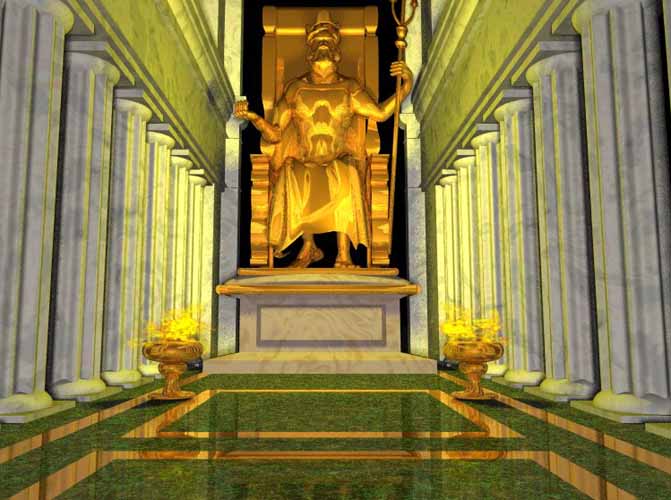
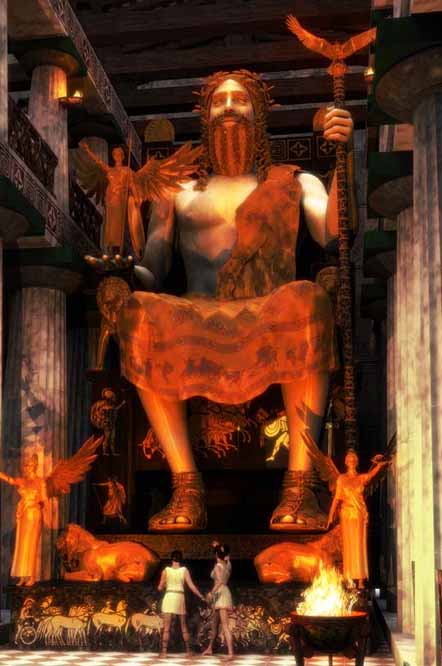
This is the statue of the god in whose honor the Ancient Olympic games were held. It was located on the land that gave its very name to the Olympics. At the time of the games, wars stopped, and athletes came from Asia Minor, Syria, Egypt, and Sicily to celebrate the Olympics and to worship their king of gods: Zeus.

The Statue of Zeus at OlympiaThe Statue of Zeus at Olympia

In the ancient world, there were many temples dedicated to Zeus, the king of the Greek gods. But, there was only one temple to Zeus that housed one of the seven wonders of the ancient world. The Temple of Zeus at Olympia was home to one of greatest sculptural achievements of ancient history. The Statue of Zeus at Olympia represented the pinnacle of Classical sculptural design, as well as showcased the engineering that was required to construct such a massive chunk of marble and gold.

The city-state of Olympia was a center of religious worship, and was also the birthplace of the Olympic games. Believed to have begun in 776 B.C., the Olympic games demonstrated the physical prowess as well as the political strength of the participating Greek poleis. The Olympic games were considered to be a part of religious rituals that revolved around the king of the Greek gods, Zeus. So it was only fitting that a grand temple and an even grander cult representation were constructed for the many Greeks who made pilgrimages there in order to worship their father god.

The temple of Zeus was built between 466 - 456 B.C., during the height of Classical Greek architecture and artistic endeavors. It was designed by Libon, an architect from neighboring Elis. The temple was constructed of local shell stone in the Doric style, the predominant architectural style of the time, and the same style as the Parthenon in Athens. The temple itself acted merely as a protective home for the real showpiece, the cult statue of Zeus himself.

The renowned Greek sculptor Pheidias brought Zeus to life with his creation around 435 B.C. After creating the cult statue of Athena for the Parthenon, Pheidias left Athens in shame as a result of a political scandal and an erroneous embezzlement charge. He immediately came to Olympia to begin work on Zeus.

Pheidias had developed a technique that allowed his enormous creations of ivory and precious metals to be formed without crumbling under their own weight. Beginning with a wooden frame built on site, he would lay thin plates of ivory soaked in a liquid to make them moldable, and place them upon the mold along with sheets of gold (for Zeus draping clothing). The pieces matched up perfectly, and the joints were nearly invisible.

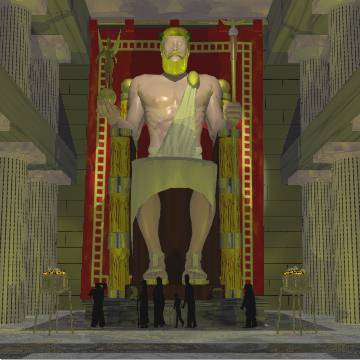
The appearance of the statue must have been imposing, impressive, and awe-inspiring. The seated statue was over 40 feet tall. Zeus' throne was just as impressive, constructed of cedar and inlaid with ivory, gold, and ebony. He held a statue of Nike, the Greek goddess of victory, in his left hand, and a staff with an eagle perched atop it in his right hand.

The statue inspired reverence for over 800 years in its temple home in Olympia. Kings and even Roman Emperors who gazed upon it were known to cry in veneration. In fact, the Roman Emperor Caligula even tried to have the statue taken for himself in the late 30's A.D., with no success. In the 450's A.D., it was taken from the temple to Constantinople, where it sat in a palace. The palace was destroyed by fire in 462 A.D., and one of the seven wonders of the ancient world was unfortunately lost forever.

Wednesday, January 20, 2010

The Great Pyramid of Giza Pictures and Photos - Info

The Wonders of the Ancient World info and Pictures : The Great Pyramid of Giza Info Pictures and Photos

The Great Pyramid, Giza PictureThe Great Pyramid, Giza Picture

The building blocks of The Great Pyramid, Giza

Egypt Giza Pyramids after sunset PhotoEgypt Giza Pyramids after sunset Photo

Giza pyramids soaring above the city PictureGiza pyramids soaring above the city Picture

Giza pyramids soaring above the city of Cairo, Egypt

The Great Pyramids in Giza PhotoThe Great Pyramids in Giza Photo

The Great Pyramid of Giza PictureThe Great Pyramid of Giza Picture


The Great Pyramid of Giza Info :

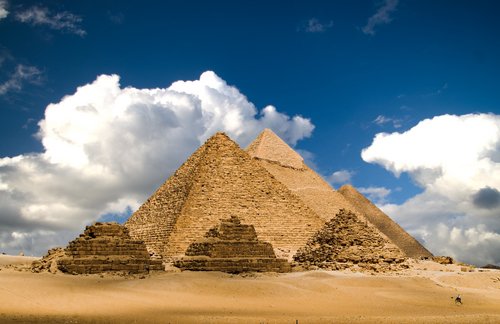
It is the one and only Wonder which does not require a description by early historians and poets. It is the one and only Wonder that does not need speculations concerning its appearance, size, and shape. It is the oldest, yet it is the only surviving of the Seven Ancient Wonders. It is the Great Pyramid of Giza.

Location:

At the city of Giza, a necropolis of ancient Memphis, and today part of Greater Cairo, Egypt.

History Of The Great Pyramid of Giza :

Contrary to the common belief, only the Great Pyramid of Khufu (Cheops), not all three Great Pyramids, is on top of the list of Wonders. The monument was built by the Egyptian pharaoh Khufu of the Fourth Dynasty around the year 2560 BC to serve as a tomb when he dies. The tradition of pyramid building started in Ancient Egypt as a sophistication of the idea of a mastaba or "platform" covering the royal tomb. Later, several stacked mastabas were used. Early pyramids, such as the Step Pyramid of King Zoser (Djoser) at Saqqara by the famous Egyptian architect, Imhotep, illustrate this connection.

The great pyramid is believed to have been built over a 20 year period. The site was first prepared, and blocks of stone were transported and placed. An outer casing (which disappeared over the years) was then used to smooth the surface. Although it is not known how the blocks were put in place, several theories have been proposed. One theory involves the construction of a straight or spiral ramp that was raised as the construction proceeded. This ramp, coated with mud and water, eased the displacement of the blocks which were pushed (or pulled) into place. A second theory suggests that the blocks were placed using long levers with a short angled foot.

Throughout their history, the pyramids of Giza have stimulated human imagination. They were referred to as "The Granaries of Joseph" and "The Mountains of Pharaoh". When Napoleon invaded Egypt in 1798, his pride was expressed through his famous quote: "Soldats! Du haute de ces Pyramides, 40 siècles nous contemplent". (Soldiers! From the top of these Pyramids, 40 centuries are looking at us)

Today, the Great Pyramid is enclosed, together with the other pyramids and the Sphinx, in the touristic region of the Giza Plateau. Also in the area is the museum housing the mysterious Sun Boat, only discovered in 1954 near the south side of the pyramid. The boat is believed to have been used to carry the body of Khufu in his last journey on earth before being buried inside the pyramid. It may also serve him as a means of transportation in his afterlife journey according to Ancient Egyptian beliefs.

Description :

When it was built, the Great pyramid was 145.75 m (481 ft) high. Over the years, it lost 10 m (30 ft) off its top. It ranked as the tallest structure on Earth for more than 43 centuries, only to be surpassed in height in the nineteenth century AD. It was covered with a casing of stones to smooth its surface (some of the casing can still be seen near the top of Khefre's pyramid). The sloping angle of its sides is 54 degrees 54 minutes. Each side is carefully oriented with one of the cardinal points of the compass, that is, north, south, east, and west. The horizontal cross section of the pyramid is square at any level, with each side measuring 229 m (751 ft) in length. The maximum error between side lengths is astonishingly less than 0.1%.

The structure consists of approximately 2 million blocks of stone, each weighing more than two tons. It has been suggested that there are enough blocks in the three pyramids to build a 3 m (10 ft) high, 0.3 m (1 ft) thick wall around France. The area covered by the Great pyramid can accommodate St Peter's in Rome, the cathedrals of Florence and Milan, and Westminster and St Paul's in London combined.

On the north face, is the pyramid's entrance. A number of corridors, galleries, and escape shafts either lead to the King's burial chamber, or were intended to serve other functions. The King's chamber is located at the heart of the pyramid, only accessible through the Great Gallery and an ascending corridor. The King's sarcophagus is made of red granite, as are the interior walls of the King's Chamber. Most impressive is the sharp-edged stone over the doorway which is over 3 m (10 ft) long, 2.4 m (8 feet) high and 1.3 m (4 ft) thick. All of the interior stones fit so well, a card won't fit between them. The sarcophagus is oriented in accordance with the compass directions, and is only about 1 cm smaller in dimensions than the chamber entrance. It might have been introduced as the structure was progressing.

New theories concerning the origin and purpose of the Pyramids of Giza have been proposed... Astronomic observatories... Places of cult worship... Geometric structures constructed by a long-gone civilization... Even extraterrestrial-related theories have been proposed with little evidence in support... The overwhelming scientific and historic evidence still supports the conclusion that, like many smaller pyramids in the region, the Great Pyramids were built by the great Ancient Egyptian civilization off the West bank of the Nile as tombs for their magnificent Kings... Tombs where Khufu, Khefre, and Menkaure could start their mystic journey to the afterlife.

Note : For the high-quality art prints of Great Pyramid of Giza Posters available at Allposters.com
For Travel advice, Hotel Accommodations tripadvisor.com