Animals Zoo Park - Amazing - Funny - Dangerous Animals

African Animals, Asian Animals, Amazing Photos, Amazing Under Water Photos Birds Photos, Flowers Pics, Free Wallpapers, Funny People Pics, Funny Pictures, Funny Videos, Hunting Videos Hunting Pics, Soccer Wallpapers, Tennis Pictures 7 Natural Wonders Information, 7 Under Water Wonders Information, 7 Wonders of the Medieval Mind, 7 Wonders of the Modern World, 7 Wonders of the Ancient World, Wonderful Temple Wallpaper, Top 10 Hollywood Stars (By visitors request), Top 10 soccer Players (By visitors request), Top 10 Tennis Players (By visitors request), 10 most Dangerous Snakes, Dangerous Animals, 10 most deadliest snakes, 10 Most Poisonous Animals in the World, all Wonders Of the World.
Showing posts with label The Seven Underwater Wonders of the World. Show all posts

Friday, January 22, 2010

Lake Baikal In Russia Pictures, Photos, Tourist Map

The Seven Underwater Wonders of the World : Russia says "Sacred lake" is 25 million years old-the oldest lake on the planet.

Lake Baikal in Russia PictureLake Baikal in Russia Picture

Lake Baikal in Russia PhotoLake Baikal in Russia Photo

Beautiful Lake Baikal PictureBeautiful Lake Baikal Picture

Lake Baikal in Russia PhotoLake Baikal in Russia Photo

In early March, snow still blankets lake Baikal, its deep waters sealed beneath three-foot-thick ice. Over the next two months, under bright springtime sun, the ice will slowly thaw in a process punctuated by cracking sounds not unlike the sharp report of guns. As long as the ice remains in place, though, scientists can set up camp right in middle of this 400-mile-long, 5,000-foot-deep lake.

Russia says "Sacred lake" is 25 million years old-the oldest lake on the planet. It is also the deepest lake, holding more water than all of North America's Great Lakes combined. It's aquatic life comprises more than 1,500 animal species and 1,000 plant species, two-thirds of which are endemic. According to marine scientist Andy Rechnitzer, Baikal is more biologically diverse than other lakes because oxygen-rich water circulates from its surface to its deepest depths, a process likely related to geothermal vents.

One of the most interesting animals in the lake is the Baikal seal, or nurpa, the world's only fresh water seal. Nurpas use their sharp claws to carve dens for their families while ice is still forming. Finding their dens is relatively easy: look for air bubbles trapped in the ice after being exhaled by nurpas. You can also look for small breathing holes poked into snowdrifts by the seals.

For a diver to get into a den is another story. First, a diving crew member must use a small metal saw to cut a small hole in the ice. Then a circular, manhole-size opening is cut with a chain saw, and long poles are used to push the round slab under the ice. To keep the hole from freezing over, it must be constantly raked. A team effort, indeed. Under the ice, the water is warmer than the air [36 degrees F], but it is still very cold for scuba diving. Every 30 seconds or so, divers must tug on safety lines attached to their wrists to let the crew above know that they are all right.

Seen from an underwater perspective, the seal's den is an intricate ice carving, complete with tunnels and an igloo-like canopy that functions as an air pocket. Nurpas are shy, and pups resting on a bunk bed of ice quickly dive into the water when startled by a visitor.

In June, conditions at Lake Baikal are much different. Although the water temperature is about the same as it is in spring, the air temperature is usually in the 60s. Visibility underwater is perhaps 200 feet, many times greater than that in most lakes. The "Great vis" at that time of year is caused by the water's relative lack of minerals and by countless small crustaceans eating the algae, plankton, and bacteria that can cloud fresh water and salt water alike. Clarity does not last long, however. By mid July, an algae bloom produces pea-soup conditions.

Except for the numbing cold that pains their ears, face, and fingers within minutes of entering the water, divers exploring the shallows of Baikal might feel as if they are hovering over a meadow on a sunny day. Looking up from a depth of 50 feet, they can see clouds in the sky. Looking down, they sea fields of fluffy green algae.

The greens spires of three-foot-tall candelabra sponges poke through the algae. Such large sponges, which get their color from algae living symbiotically in their tissues, are not rare in saltwater, but in other freshwater lakes they have no parallel. The sponges are homes for amphipods, alien-looking shrimplike creatures that are as small as specks or as large as human thumbs. And the waters of Lake Baikal hold 240 species of them.

Hiding among the sponges and algae are sculpins, bottom-dwelling fish that are masters of camouflage, their patterned bodies blending in with their surroundings. These ancient fish, like most cold-water species, don't move fast; it's just too cold here to make quick moves. So, the lake's 40 species of sculpins, comprising 80 percent of Baikal's fish biomass, rely on camouflage for protection against larger fish. Pear

Near the lakes northern and, at a depth of approximately 1,350 feet, a geothermal vent provides warmth for the community of sponges, snails, worms, and fish living in the pitch-dark environment. The existence of this vent confirms that Baikal is a place where continental masses are being pulled apart. Photographer Emory Kristof, who has visited the site for the National Geographic Society, explains: "The communities of life resemble organisms normally found in an ocean, which gives weight to the theory that Baikal is an ocean in the making."

One rarely seen creature is the omul, a delicious fish endemic to the lake. Its scarcity indicates Baikal is ecologically out of balance, a result of the destructive effects of industrial development and logging nearby. Vadim Fialkov, of the lake Baikal Limnological Institute, reports that "local environmental groups have put pressure on the government to reduce the amount of effluents that are dumped into the lake. With some luck, we'll get Baikal back to its pristine state and keep it that way. "To help the effort, UNESCO has recommended that the lake and its watershed be designated a World Heritage Site." Courtesy By : Wonderclub.com

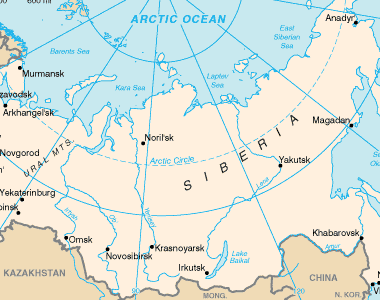
Lake Baikal In Russia Tourist Map :

Baikal Amur RailwayBaikal Amur Railway

Map of Lake Baikal courtsey: baikaler.com

Map of Lake Baikal - World's Largest Freshwater Lakeby volume- Image by CIA Map of Lake Baikal - World's Largest Freshwater Lakeby volume- Image by CIA

Lake Baikal RingLake Baikal Ring

Often called the Pearl of Siberia, Lake Baikal is a natural wonder that almost defies description. Its 1600 meter (almost 1 mile) depth holds 20% of all the freshwater (melted condition) on the planet. It is fed by 336 rivers and streams that flow from the surrounding mountains and all parts of Siberia and it is estimated that it took over 400 years for these rivers and streams to fill the lake up originally. It is considered the oldest lake in the world.

Thursday, January 21, 2010

The Belize Barrier Reef Info Photos - Pictures

The Belize Barrier Reef Photos and Pictures :


The Belize Barrier Reef Photo

The Belize Barrier Reef Picture

The Belize Barrier Reef Info:

The second largest barrier reef in the world rises from the seafloor off the coast of Belize. A diver's paradise, it is known for fascinating coral formations, myriad fish and invertebrates, and exceptional water clarity.

On the ocean side of this 160-mile-long reef is a popular tourist designation known as Lighthouse Reef. Here, crystal-clear waters fill the famous Blue Hole, a crater more than 1,000 feet across and just over 400 feet deep. At the surface, healthy coral formations rim this wonder within a wonder, but at a depth of 125 feet, neither corals nor fish can be found. Instead, a diver finds stalactites formed during the Ice Age, when the world sea level was much lower and the Blue Hole was a subterranean cavern. The hole formed when the cavern's roof collapsed.

To the south is Glover's Reef, surrounded by waters so clear that visibility even at night is quite good: The long shaft of a diver's torch can pierce the water to a distance of 15 feet. Because it is several miles from the mainland, this reef is not affected by silt and sediment runoff. At Glover's, the arrival of a diver startles bright red cardinalfish swimming in open water, they rely on organs called lateral lines running along both sides of their bodies. A combination of sonar and radar, a lateral line senses vibrations and movements in the water, allowing fish to detect predators and pray. It's also an early warning device. As a fish swims, it creates a sort of bow wake that bounces off solid objects. When another fish feels the wake, it moves to avoid a collision.

Glover's Reef is home to the Emerald Forest, a site named for magnificent elk horn coral "trees" having trunks a foot diameter and canopies more than ten feet high. Several kinds of exotic fish also live here, and at night, a camera-bearing diver can catch them asleep, tucked in against the reef, but still out in the open. Butterflyfish as colourful as backyard butterflies hover in the water. So do hogfish with pig like snouts, trumpetfish that look like two-foot-long musical instruments, and parrotfish, their beaklike mouths closed for the night.

Not all of the reef's creatures are lost in sleep, however. Manta rays and sharks prowl the darkness, seeking meals. Lobsters, crabs, shrimp, and nudibranchs (the beautiful slugs of the sea) search the reef for food and mates. A Nassau grouper gets its mouth "cleaned" by a tiny shrimp, which darts from side to side and from top to bottom to remove small parasites and dead flesh from the cooperative fish, its mouth frozen in a wide yawn. The shrimp gets a free meal, so to speak. Dr. Mary Wicksten, a marine biologist at Texas A&M University and a specialist in these so-called cleaning stations, says that fish seek out established stations on the reef because the activity is important for their health. Like several other reef fish, the Nassau grouper is remarkable for its ability to change sex as it gets older, increasing its chances for reproductive success when another grouper is met.

At a natural cut in Glover's Reef, where water surges during the changing of the tide, a diver can free-fall horizontally, whipped along by the strong current. But fish hover without obvious effort, their streamlined bodies designed by nature to keep them in place in such conditions. Jutting from the walls of the cut, like fingers on a huge hand, are lavender tube sponges that eat by filtering tiny plants and animals from the sea. Soft coral sea fans, also filter feeders, bend in the breeze like underwater current that brings them a constant supply of food. The dominant life-form here is the hard coral, which is capable of withstanding the force of very strong wave action.

Where the current exits this canyon, it stirs up sand from the floor of a lagoon, reducing visibility. Somewhere near the bottom, turtles and manatees leisurely feed on sea grasses, while small coral heads form mini-reefs alive with tiny fish.

Across the lagoon is the Hol Chan Marine Reserve, a small area off Ambergris Cay where the tangled roots of a mangrove forest reach into the water. Even here, small fish dart among the roots, looking for meals or protection from predators.

Hol Chan, which is Maya for "the cut," was established in 1987. It encompasses all three habitats of the barrier reef ecosystem: reef, lagoon, and mangroves. Although separate, each area depends on the others. Marine scientist Jacque Carter, who has long studied Belize's fish, writes: "The mangroves are a feeding and breeding ground for reef fishes; they also trap silt and sediment runoff before it reaches the reef. The lagoon is...a feeding ground for many reef fishes, and the sea grasses...trap reef-smothering particles [keeping them] from reaching the lagoon, mangroves and shore areas from destructive wave action. If one area is damaged, the others are also affected – which is why it is important to protect the entire system, and not just the beautiful coral reef."

Pinnacle reefs to the lea of the Belize Barrier Reef: Jim Ebanks photo

Belize Blue Hole Lighthouse Reef.

Note reef platforms within the Belize Barrier Reef. Note the pinnacle reefs within the barrier rims to these patches.

Belize Barrier ReefAfter Noel James.Belize Barrier ReefAfter Noel James.

Photos From : USC Sequence Stratigraphy

The Galapagos Islands Info Pictures - Photos

The Galapagos Islands Info Pictures - Photos

If you love animals and nature, where else can be ideal for you but Galapagos Islands?

The instant your feet will touch this fantastic land it will seem you to live in a great spectacular zoological natural park, surrounded by the most different flora and fauna you can ever imagine. If you look up and around you can see many species of birds (the famous and funny “Bobo”, the “Mocking Bird” the “Frigate bird” and Hawks). A colorful show, but there are other types of animals : “Beach basking beasts” and the Land Iguana Diving in the splendid local sea we can swim near Penguins or incredible big Centurion Marine turtle; but pay attention: don’t step over a Light foot Crab (it’s of a light orange colour when it grows, but when it is small is almost black to hide on the sand and avoid to be predate so it’s difficult to individuate). If you like a night time dive you can swim with the swallow tailed gulls that are hunting the night swimming marine life of the sea’s water. For all it’s natural species this islands inspired also Charles Darwin that after living there 5 weeks thought his Theory of evolution.One more time you travelled between history and natural wonders. by .Prontohotel


Rising from the Pacific 600 miles west of Ecuador are arid islands whose name, for obvious reasons, is a Spanish word for tortoises. Indeed, the Galapagos islands are famous for tortoises weighing hundreds of pounds. What many people don't know, though, is that fascinating creatures also live in an undersea realm offshore.

Describing the contrast between the islands and their underwater bounty in a the 1924 book of, Galapagos: World's End, William Beebe wrote: "Host of sally-lightfoots [tidal crabs] were the most brilliant spots of color above the water in the islands, putting to shame the dull, drab hues of the terrestrial organisms and hinting at the glories of colorful animal life beneath the surface of the sea. "

Four currents converge in Galapagos waters: the Peru or Humboldt to from the south, the Equatorial from the West, the North Equatorial, and the Panama. Fish and invertebrates from different oceans and habitat ride these currents and quickly make themselves at home along the rocky shores, on a sandy sea bottom, and in the mangrove forests of the Galapagos.

Among the most playful creatures here are the sea lions. Slicing through the water at dazzling speed, they sometimes perform an underwater ballet of sorts, twisting, turning, stretching, and arching their sleek bodies amid clouds of plankton. A sea lion will swim just inches from a diver's mask as if approaching for a kiss, or it will nibble at a swim fin or embrace the diver with its flippers, all the while maintaining eye contact-a technique that requires incredible flexibility and agility.

A sea monster the size of a school bus also lives in Galapagos waters: the whale shark. Largest fish in the sea, it eats plankton and fish strained from the water by its wide mouth. Although encounters with it are rare here, encounters with other sharks are not. Six- to eight-foot-long hammerhead sharks, with heads shaped like sledgea hammers, swim in schools of a hundred or more. White-tip, Galapagos, and bull sharks, most larger than a man, are seen by nearly every explorer who enters these waters. Getting pictures of them while diving is difficult, though, because a diver's bubbles seem to frighten them.

Among the more unlikely denizens of equatorial waters are Galapagos Penguins. Only here and along the Pacific coast of South America do Penguins live near the Equator. They ply these waters with great ease, chasing fish and avoiding sharks. Out of water, they may be seen waddling about on the islands' volcanic rocks.

Another unique animal is the marine iguana, a ferret-size lizard whose distinctly reptilian features are adaptations for its life in the Galapagos: it uses its blunt snout to scrape algae from submerged rocks, it's clawed feet to grip slippery rocks, its muscular body and tail to swim in strong tides, and its spines to defend against predators.

Although the archipelago holds many wonders, it does not have a coral reef. Instead, diver's find dramatic volcanic rock formations beneath the sea. Some of them are bare; others are covered by red algae, orange and costing sponges, orange cup corals, and bushes of black coral.

One reason for the low number of reef-building corals is a weather phenomenon called El Nino. Periodically, El Nino brings an incursion of water that is poor in nutrients and unusually warm; these conditions are unfavorable for corals and plankton. El Nino also causes rainfall to increase, and large amounts of freshwater added to seawater are detrimental to coral growth.

Conversely, these seas hold a high number of fish-300 species, of which 17 percent are endemic. Among them are the hieroglyphic hawkfish, a bottom-dweller that seems to have symbols etched on its body, and the red-lipped batfish, with fashion-model-red lips. Not surprisingly, the archipelago attracts many fishermen.

Although the area is protected by an 1986 presidential decree making it the Marine Resource Reserve, it is still the site of illegal fishing. Park rangers simply don't have the resources to patrol almost 30,000 square miles. Luckily, the conservation effort is strong, being led in part by the owner of live-aboard dive vessels, Herbert Frei, Jr., who says that a plan is in the works to provide fisherman with a livelihood, while not significantly affecting the underwater habitat.

Efforts are also under way to save the islands' terrestrial animals, especially the tortoises. Because their shells come in different sizes and shapes-domed, saddle-back, or somewhere in between-these gentle giants formerly were thought to be members of several species. In fact, there is only one species, and it was almost wiped out by hunting and habitat destruction. Today, scientists at the Charles Darwin Research Station are working to protect and, in some cases, reintroduce the giant tortoises to more remote areas of the archipelago.

Fortunately some 750,000 birds still can be found among the islands. Flycatchers, mockingbirds, yellow warblers, hawks, owls, and finches are common. So far 19 species of seabirds, including the blue-footed booby, red-footed booby, frigate bird, and the waved albatross.

When naturalized Charles Darwin first came to the Galapagos in 1835, he noticed that animals of the same species looked different on different islands. Years later, he developed a revolutionary theory of evolution and wrote On the Origin of Species by Means of Natural Selection. What might he have thought if he had also seen the remarkable creatures in the sea surrounding islands?
> Source: The Wonders of the World, National Geographic Society


Wednesday, January 20, 2010

Palau Islands Pictures Info and Photos

The Seven Underwater Wonders of the World : Information about Palau Islands with Pictures and Photos.

> There are more than 250 islands in the Republic of Palau—though about 70 percent of its people live in the capital city of Koror. Tourists drive the nation's economy, most are drawn by the world class diving in their coastal waters. By Travel.Nationalgeographic

Palau Islands Picture
Palau Islands Photo
Wonderful Palau Islands Photo
World Wonder Palau Islands Picture


The Seven Underwater Wonders of the World About Palau : The warm waters of Palau, a small archipelago in the Pacific Ocean, hold perhaps the richest and most biologically diverse coral reefs on the planet. In this "cradle of diversity," marine biologists have recorded 700 species of corals and 1,500 species of fish.

Palau's coral reefs began to grow millions of years ago when coral polyps colonized submerged volcanic mountains. The tiny polyps produced a material that cemented them in place. Side by side, they built hard, external skeletons around their soft bodies, and when they died, other corals built skeletons on top of them. Geologic forces eventually raised the coral topped mountains above the sea, and all the exposed corals died. In time, new colonies built more reefs on the islands undersea slopes.

Today, divers swimming over the coral gardens of Ngemelis Island are moved by nature's artistry and creativity. The top of this reef, just a few feet below the surface, resembles wild flowers swaying in the breeze. Here, soft coral trees and bushes seem to have been painted in stunning shades of green, red, yellow, and orange.

Among the many fish species fluttering around gracefully are yellow butterflyfish, blue-headed wrasses, and emperor angelfish-black masked and striped. Not so graceful, though, is the mango-size puffer, a fish that sucks in water when startled and inflates its body to the size of a football. Sharp spikes stick out in all directions and are quite a deterrent to potential predators. Another cumbersome swimmer is the pear-sized trunkfish, whose tough, trunklike body is difficult for predators to chew.

Nestled among the Ngemelis corals are giant clams. These two- or three-foot-long creatures, depicted in early movies as being able to grab divers' feet, feed harmlessly on plankton-not divers. And poking ever so slightly out of cracks in the corals are green and red brittle stars. Related to sea stars, these animals grow arms that break off easily if bitten by predators or touched by scuba divers. Brittle stars hide until sundown, but at night they crawl out, spread their arms, and feed on plankton.

Sometimes the best way to observe fish is to find a sandy patch, settle down, and wait, letting them get accustomed to you. And a good technique for finding a particular kind of fish is to look from right to left, rather than left to right-the usual way in which people view things. Looking in this manner slows down the viewing process and increases the odds of sighting an animal.

Not difficult to spot are watermelon-size cuttlefish hovering in the water. Related to the octopus and squid, these members of the cephalopod group can change their colors, patterns, and shapes so that they sometimes look like floating plants or free-swimming octopuses, their arms tickling unseen objects. Another master at deception is the crocodilefish. A lie-in-wait predator, this three-foot-long fish has an uncanny resemblance to its reptilian namesake.

One of the greatest underwater shows on earth can be seen at Blue Corner, a part of the archipelago named for the deep blue quality of its water. Here, currents strong enough to rip the mask from a diver's face bring in a healthy supply of plankton, a food source that attracts unicornfish, tangs, and other plankton-eaters. In turn, these fish attract huge schools of predators, including sharks and jacks. The school of jacks can number 300 or 400 and be so dense that it nearly blocks the sunlight, creating the effect of an underwater eclipse. Blue Corner also attracts manta rays and eagle rays. With wingspans of several feet, these large plankton-feeders have few predators and can feed leisurely without having to worry about the ever present sharks patrolling the reef.

At Blue Corner, the currents are so fast that a diver's encounter with a pelagic fish may last only a few minutes before he or she is whisked into the open ocean. Some divers overcome the time constraints of current diving by using a reef hook, a three-foot-long line with a hook at both ends. One hook attaches to a scuba vest and the other to a nook or cranny in the reef. The hook extends the dive, but in the process of setting, adjusting, and releasing it, a diver damages the fragile corals. Healthy coral gardens are found in many other areas of Palau, but at Blue Corner major areas of coral are now barren white patches of rock. This little corner of the world shows what can happen when underwater wonders are overwhelmed by people's desire to see them at any cost.

Among Palau's other attractions are 80 marine lakes. Jellyfish lake, with its extraordinary jellyfish population, is the most visited. Like the others, it is dark green, has poor visibility, and is as warm as bathwater. Each day, jellyfish slowly follow the sun's path across the lake, soaking up sunlight for the life-supporting algae in their tissues. Because they haven't needed to protect themselves from predators, these jellyfish have lost the ability to sting. Their lake was sealed off from the open ocean eons ago, and jellyfish-eaters, such as turtles, were locked out. Without the threat of getting stung, today's underwater explorers can swim freely among yellow polka-dotted jellyfish shimmering harmlessly in the sun. Courtesy By Wonder Club

> By Visitors Request We added extra Categories : Top Female Tennis Stars