Animals Zoo Park - Amazing - Funny - Dangerous Animals

African Animals, Asian Animals, Amazing Photos, Amazing Under Water Photos Birds Photos, Flowers Pics, Free Wallpapers, Funny People Pics, Funny Pictures, Funny Videos, Hunting Videos Hunting Pics, Soccer Wallpapers, Tennis Pictures 7 Natural Wonders Information, 7 Under Water Wonders Information, 7 Wonders of the Medieval Mind, 7 Wonders of the Modern World, 7 Wonders of the Ancient World, Wonderful Temple Wallpaper, Top 10 Hollywood Stars (By visitors request), Top 10 soccer Players (By visitors request), Top 10 Tennis Players (By visitors request), 10 most Dangerous Snakes, Dangerous Animals, 10 most deadliest snakes, 10 Most Poisonous Animals in the World, all Wonders Of the World.
Showing posts with label The Seven Wonders of the Medieval Mind. Show all posts

Monday, January 25, 2010

Stonehenge Info Pictures of Stonehenge

The Seven Wonders of the Medieval Mind : Stonehenge Info - Stonehenge Pictures and Wallpapers

StonehengeStonehenge

Stonehenge Wonders PictureStonehenge Wonders Picture

Stonehenge at Sun set PicsStonehenge at Sun set Pics

Stonehenge PicturesStonehenge Pictures

Stonehenge PictureStonehenge Picture

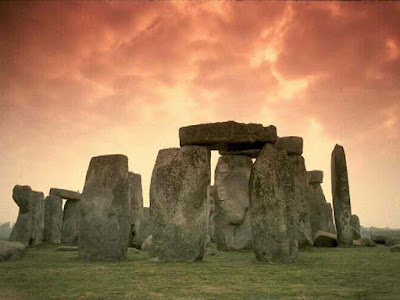
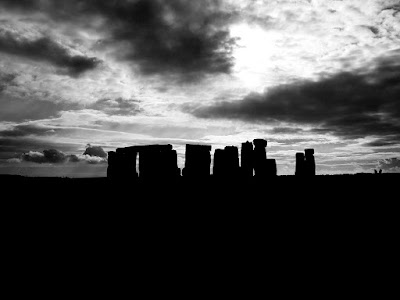
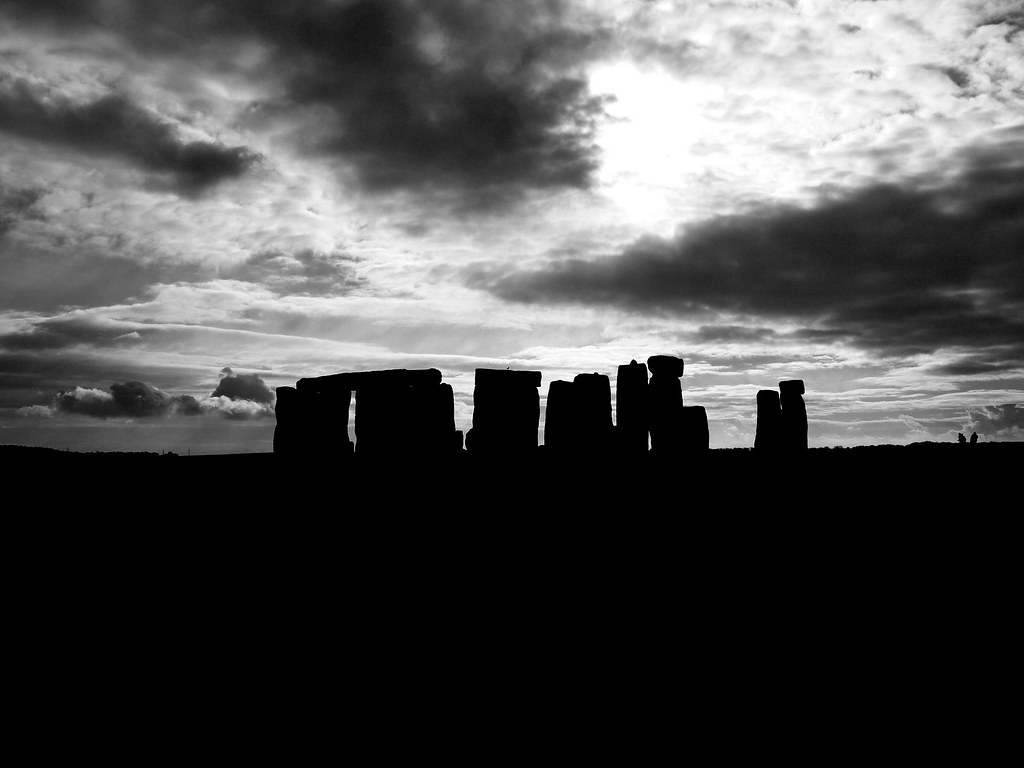
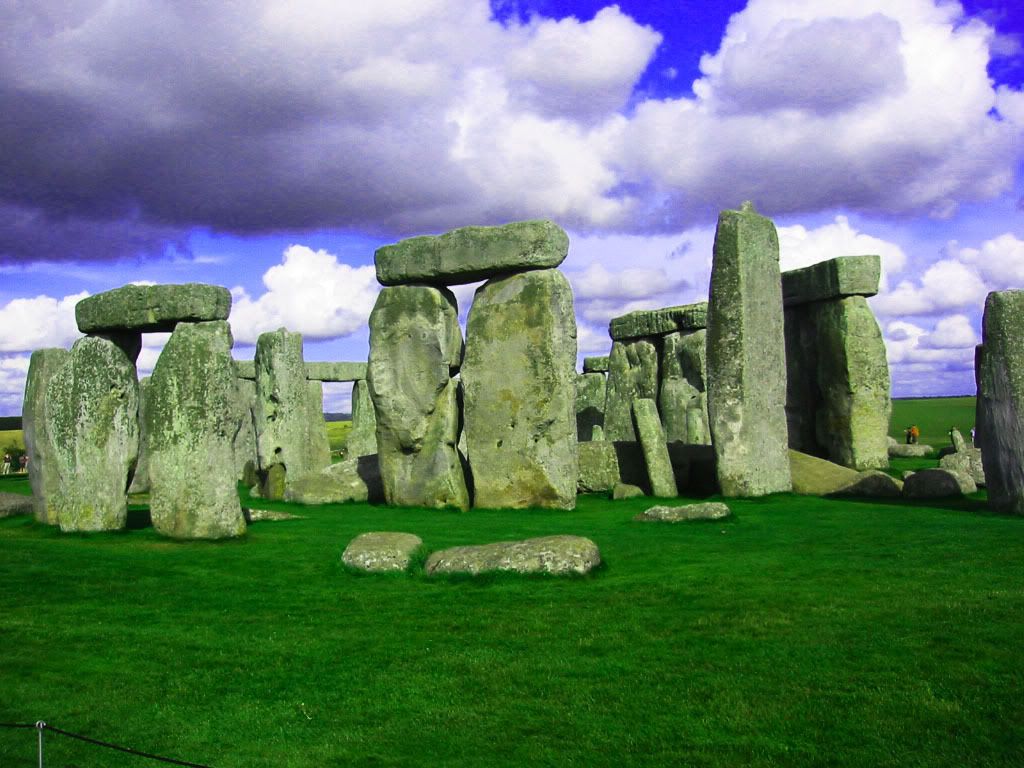
Stonehenge Info : Stonehenge is surely Britain's greatest national icon, symbolizing mystery, power and endurance. its original purpose is unclear to us, but some have speculated that it was a temple made for the worship of ancient earth deities. It has been called an astronomical observatory for marking significant events on the prehistoric calendar. Others claim that it was a sacred site for the burial of high-ranking citizens from the societies of long ago.

While we can't say with any degree of certainty what it was for, we can say that it wasn't constructed for any casual purpose. Only something very important to the ancients would have been worth the effort and investment that it took to construct Stonehenge.

The stones we see today represent Stonehenge in ruin. Many of the original stones have fallen or been removed by previous generations for home construction or road repair. There has been serious damage to some of the smaller bluestones resulting from close visitor contact (prohibited since 1978) and the prehistoric carvings on the larger sarsen stones show signs of significant wear.

Construction of the Henge In its day, the construction of Stonehenge was an impressive engineering feat, requiring commitment, time and vast amounts of manual labor. In its first phase, Stonehenge was a large earthwork; a bank and ditch arrangement called a henge, constructed approximately 5,000 years ago. It is believed that the ditch was dug with tools made from the antlers of red deer and, possibly, wood. The underlying chalk was loosened with picks and shoveled with the shoulderblades of cattle. It was then loaded into baskets and carried away. Modern experiments have shown that these tools were more than equal to the great task of earth digging and moving.

The Bluestones About 2,000 BC, the first stone circle (which is now the inner circle), comprised of small bluestones, was set up, but abandoned before completion. The stones used in that first circle are believed to be from the Prescelly Mountains, located roughly 240 miles away, at the southwestern tip of Wales. The bluestones weigh up to 4 tons each and about 80 stones were used, in all. Given the distance they had to travel, this presented quite a transportation problem.

Modern theories speculate that the stones were dragged by roller and sledge from the inland mountains to the headwaters of Milford Haven. There they were loaded onto rafts, barges or boats and sailed along the south coast of Wales, then up the Rivers Avon and Frome to a point near present-day Frome in Somerset. From this point, so the theory goes, the stones were hauled overland, again, to a place near Warminster in Wiltshire, approximately 6 miles away. From there, it's back into the pool for a slow float down the River Wylye to Salisbury, then up the Salisbury Avon to West Amesbury, leaving only a short 2 mile drag from West Amesbury to the Stonehenge site.

Construction of the Outer Ring The giant sarsen stones (which form the outer circle), weigh as much as 50 tons each. To transport them from the Marlborough Downs, roughly 20 miles to the north, is a problem of even greater magnitude than that of moving the bluestones. Most of the way, the going is relatively easy, but at the steepest part of the route, at Redhorn Hill, modern work studies estimate that at least 600 men would have been needed just to get each stone past this obstacle.

Once on site, a sarsen stone was prepared to accommodate stone lintels along its top surface. It was then dragged until the end was over the opening of the hole. Great levers were inserted under the stone and it was raised until gravity made it slide into the hole. At this point, the stone stood on about a 30° angle from the ground. Ropes were attached to the top and teams of men pulled from the other side to raise it into the full upright position. It was secured by filling the hole at its base with small, round packing stones. At this point, the lintels were lowered into place and secured vertically by mortice and tenon joints and horizontally by tongue and groove joints. Stonehenge was probably finally completed around 1500 BC.

Who Built Stonehenge? The question of who built Stonehenge is largely unanswered, even today. The monument's construction has been attributed to many ancient peoples throughout the years, but the most captivating and enduring attribution has been to the Druids. This erroneous connection was first made around 3 centuries ago by the antiquary, John Aubrey. Julius Caesar and other Roman writers told of a Celtic priesthood who flourished around the time of their first conquest (55 BC). By this time, though, the stones had been standing for 2,000 years, and were, perhaps, already in a ruined condition. Besides, the Druids worshipped in forest temples and had no need for stone structures.

The best guess seems to be that the Stonehenge site was begun by the people of the late Neolithic period (around 3000 BC) and carried forward by people from a new economy which was arising at this time. These "new" people, called Beaker Folk because of their use of pottery drinking vessels, began to use metal implements and to live in a more communal fashion than their ancestors. Some think that they may have been immigrants from the continent, but that contention is not supported by archaeological evidence. It is likely that they were indigenous people doing the same old things in new ways.

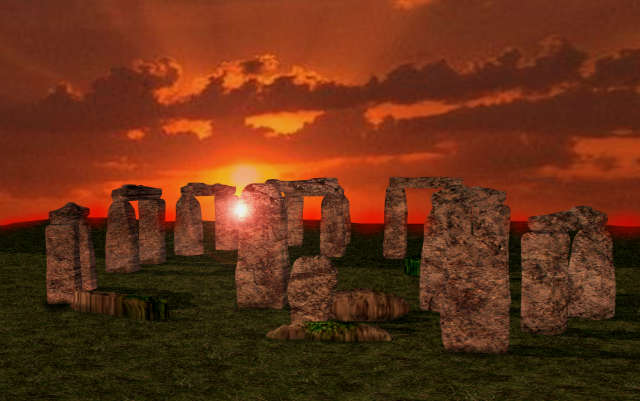
As Legend Has It The legend of King Arthur provides another story of the construction of Stonehenge. It is told by the twelfth century writer, Geoffrey of Monmouth, in his History of the Kings of Britain that Merlin brought the stones to the Salisbury Plain from Ireland. Sometime in the fifth century, there had been a massacre of 300 British noblemen by the treacherous Saxon leader, Hengest. Geoffrey tells us that the high king, Aurelius Ambrosius, wanted to create a fitting memorial to the slain men. Merlin suggested an expedition to Ireland for the purpose of transplanting the Giant's Ring stone circle to Britain. According to Geoffrey of Monmouth, the stones of the Giant's Ring were originally brought from Africa to Ireland by giants (who else but giants could handle the job?). The stones were located on "Mount Killaraus" and were used as a site for performing rituals and for healing. Led by King Uther and Merlin, the expedition arrived at the spot in Ireland. The Britons, none of whom were giants, apparently, were unsuccessful in their attempts to move the great stones. At this point, Merlin realized that only his magic arts would turn the trick. So, they were dismantled and shipped back to Britain where they were set up (see illus. at right) as they had been before, in a great circle, around the mass grave of the murdered noblemen. The story goes on to tell that Aurelius, Uther and Arthur's successor, Constantine were also buried there in their time*.

Present Day Stonehenge Situated in a vast plain, surrounded by hundreds of round barrows, or burial mounds, the Stonehenge site is truly impressive, and all the more so, the closer you approach. It is a place where much human effort was expended for a purpose we can only guess at. Some people see it as a place steeped in magic and mystery, some as a place where their imaginations of the past can be fired and others hold it to be a sacred place. But whatever viewpoint is brought to it and whatever its original purpose was, it should be treated as the ancients treated it, as a place of honor .

The modern age has not been altogether kind to Stonehenge, despite the lip service it pays to the preservation of heritage sites. There is a major highway running no more than 100 yards away from the stones, and a commercial circus has sprung up around it, complete with parking lots, gift shops and ice cream stands. The organization, English Heritage, is committed to righting these wrongs, and in the coming years, we may get to see Stonehenge in the setting for which it was originally created. Despite all its dilapidation and the encroachment of the modern world, Stonehenge, today, is an awe-inspiring sight, and no travel itinerary around Britain should omit it.

Wonderful Lighting PictureWonderful Lighting Picture

Beautiful Gallery WallpaperBeautiful Gallery Wallpaper

Stonehenge WallpaperStonehenge Wallpaper

Wonders Gallery Photo Wonders Gallery Photo

Tuesday, January 19, 2010

Information About The Great Wall of China Pics and Photos

The Seven (7) Wonders of the Medieval Mind : Information About The Great Wall of China - Picture and Photos

The Great Wall of China PhotoThe Great Wall of China Photo

The Great Wall of China From the space PicsThe Great Wall of China From the space Pics

The white watercourse that meanders from the middle of the left side down to the bottom of the image is the initial part of the 1500-km-long Da Yunhe or Grand Canal, a linked series of natural and man-made waterways that represents an engineering achievement on a par with the Great Wall (Credit for image and legend: ESA).

The Great Wall of China Early Morning PicsThe Great Wall of China Early Morning Pics

The Great Wall of China Beautiful PhotoThe Great Wall of China Beautiful Photo
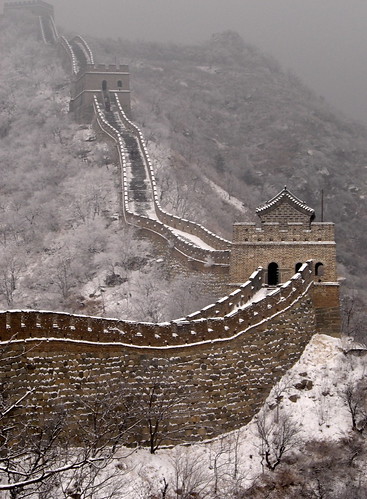
The Great Wall of China at "Mutianyu" just north of Beijing under a recent blanket of snow.

The Great Wall of China at Night PictureThe Great Wall of China at Night Picture


The Great Wall of China HISTORY :
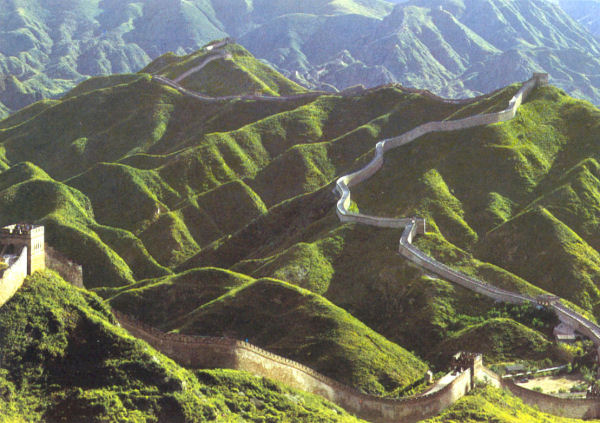
The Great Wall started as earth works thrown up for protection by different States. The individual sections weren't connected until the Qin dynasty (221-206 B.C.). Qin Shihuangdi, First Emperor of Qin began conscripting peasants, enemies, and anyone else who wasn't tied to the land to go to work on the wall. He garrisoned armies at the Wall to stand guard over the workers as well as to defend the northern boundaries. The tradition lasted for centuries. Each dynasty added to the height, breadth, length, and elaborated the design mostly through forced labor.

It was during the Ming dynasty (1368-1644) that the Wall took on its present form. The brick and granite work was enlarged and sophisticated designs were added. The watch towers were redesigned and modern canon were mounted in strategic areas. The Portuguese had found a ready market for guns and canon in China, one of the few items of trade that China didn't already have in abundance. The Ming Emperors, having overthrown the Hun dominance and expelled their Mongol rulers of the North devoted large portions of available material and manpower to making sure that they didn't return.

Throughout the centuries, armies were garrisoned along the length of the Wall to provide early warning of invasion and a first line of defense. Great piles of straw and dung used to build signal fires have been found during excavations. There must have been small garrison towns spotted along the length. There weren't many farms or trade towns to provide ease, relaxation and food. The supply trails were over mountains along narrow paths. To bring supplies to the top, ropes were slung over posts set in the Chinese side of the wall and baskets were hauled up hand over hand. Supplies must have always been short and chancy, particularly in the winter.

The Wall served well. Only when a dynasty had weakened from within were invaders from the north able to advance and conquer. Both the Mongols (Yuan Dynasty, 1271-1368) and the Manchurians (Qing Dynasty,1644-1911) were able take power, not because of weakness in the Wall but because of weakness in the government and the poverty of the people. They took advantage of rebellion from within and stepped into the void of power without extended wars.

Over the past few centuries, the Great Wall has served as a source of building materials for local farms and villages. Aerial photos show that in sections, only the top battlements show -- the center of the wall has filled with sand and silt. The same brutal isolated conditions which made the Great Wall a triumph of engineering and determined planning make restoration problematic and slow.


There are tons of questions about the Great Wall of China: Can you see it from the moon? What was it’s purpose? Who built it, and why? Are people buried underneath it?

Facts of Great Wall of China :

The Great Wall of China has been a part of the Chinese history and it is one of the Seven Wonders of the World. One of the interesting facts about this great wall china is that the great wall of china is visible from space.

The Great Wall of China as built over 2000 years ago, around 221 BC but most of the current Great Wall was built during the period between 1368 and 1644.The Great Wall of China is one of the longest structures ever built by men.

The main purpose of the Great Wall of China was to protect China from attack by northern tribes (such as the Mongols). From records it appears that many thousands of people were involved in the constructing the Great Wall of China around 300,000 soldiers and 500,000 common people were involved this Great Wall of China.During the construction of the Great Wall of China many people lost their lives many human remains buried under sections of the wall.

The approximate measure of the Great Wall of China is 6000 kilometer long but it is believed that the actual measurement will be 50000 kilometers. The Great Wall of China is 25 feet tall and it ranges from 15 to 30 feet wide.

> Learn More at WikiPedia : Wikipedia’s Great Wall of China Entry
> Great Wall of China Resources : Strongly recommended articles about the Great Wall of

> Present Condition of Great Wall of China :

Estimates say that only 20% of the Great wall China is in good condition. Many portions of the wall have been repaired, some are in total disrepair

> Dimenssions of Great Wall of China :

The Great Wall of China is 25ft high and 30ft thick. Length of Great Wall of China is 1500 miles.

> Material Used in Construction of Great Wall of China :

Whatever materials were available near the construction site was used for the purpose. In some places limestone was used, in some places granite was used and where nothing was available dirt from the surrounding area was used which were cemented with egg whites and sticky rice. Around 1 million laborers toiled day and night to construct this wall. Hundreds of them died due to exhaustion and starvation. It is said that their bodies were used as rubble in constructing the wall. The Great Wall was said to be the "longest cemetery in the world".

Monday, January 18, 2010

The Colosseum Rome Italy Pictures and Wallpapers

The Seven Wonders of the Medieval Mind : The Colosseum Rome Italy Pictures and Wallpapers at night and Inside.

The Colosseum Rome Italy In NightThe Colosseum Rome Italy In Night

The Colosseum Rome Italy In sideThe Colosseum Rome Italy In side

The Colosseum Rome Italy at Early MorningThe Colosseum Rome Italy at Early Morning

The Colosseum Rome ItalyThe Colosseum Rome Italy

The Colosseum Rome ItalyThe Colosseum Rome Italy

Colosseum is one of the greatest architecture ever built in the history of Rome. The Colosseum was originally known as the Flavian Amphitheatre and is the largest amphitheater to have ever been built in the Roman Empire. It is a circular structure that occupies a site east of the Roman Forum. This Amphitheater was built to organize gladiator contests, dramas and games like hunting animals, constructing mock sea battle and the public could also view it in the open, and cheer their favorites.

Built in the center of Rome itself, its construction began sometime between 70 and 72 AD and was completed in 80 AD when Titus was the ruling emperor. It has a seating capacity of 50,000 spectators. The Colosseum over the years has been broken by natural disasters like earthquake; even then, it is one of the hot spot of tourist visits in Rome. Very near to the Colosseum is the training school for the gladiators and it is worth the look. As compared to the oval shape of the Colosseum, it is triangular in shape. Other areas of attraction are places where the armor was built, then where the wounded gladiators were cured and not to forget the burial ground where the dead gladiators rested in peace.

Today, the Colosseum is used for religious purposes. The Pope leads a procession on good Fridays called the station of the cross. Currently, the Amphitheater is very rich in Flora. There are more then hundreds of different kinds of Flora present on the ancient walls of the Colosseum. The Colosseum of Rome has been given great importance by the media and that is the reason why a lot of Hollywood movies have been shot in this amphitheater. The famous movie “Gladiator” is highly influenced by the Roman culture and the gladiator contests.

Traveling to the Colosseum :

The fascinating history that involves bloodbaths and battles associated with the structure is what draws visitors to this historical site. Getting to the Colosseum by taxi or bus from the airport is easy enough, but the line to get into the site itself can be excruciatingly long, especially during the very busy summer season. Aside from going there at any other time, there are other ways to get around these long lines. You can buy your ticket either at the Roman Forum or the Via de San Gregorio (these ticket counters are usually line-free), or you can even get them online. You can also buy a combo ticket that covers several of Rome’s main attractions, or call the office to reserve your ticket in advance. Another good way to avoid long lines at the Colosseum entrance is by joining a tour group.

The Porcelain Tower of Nanjing Pics and Info

The Seven Wonders of the Medieval Mind Information : About The Porcelain Tower of Nanjing Pics and Info.

The Porcelain Tower of Nanjing PicsThe Porcelain Tower of Nanjing Pics

The Porcelain Tower of Nanjing PhotoThe Porcelain Tower of Nanjing Photo

The Porcelain Tower of NanjingThe Porcelain Tower of Nanjing

The Porcelain Tower of Nanjing PicsThe Porcelain Tower of Nanjing Pics


Location:
Nanjing, China, out on the banks of the Yangtze.

History:
The people of China called it Bao'ensi, the "Temple of Gratitude." European visitors who beheld the structure called it the Porcelain Tower of Nanjing and labeled it one of the wonders of the world. But warfare and subsequent destruction overtook it in the 19th century, and this remarkable structure was almost lost to history, virtually forgotten by the world.

Still, for many people who had known the tower firsthand, it was a sublimely elegant example of a Buddhist pagoda. "The best contrived and noblest structure of all the East," wrote Le Comte, the French mathematician who had made a visit to China in the early 19th century.

Description :
From an octagonal base about 97 feet in diameter, the tower's nine stories rose pyramidally to a height of about 260 feet. According to information obtained by an American missionary who journeyed to Nanjing in 1852, the original plan for the tower had called for 13 stories and a total height of about 330 feet. Although those ambitious dimensions were never realized, the smaller size made little difference, because size was not what made the structure so memorable for visitors.

The brilliant white porcelain bricks that faced the tower were what made it so unforgettable. By day, the bricks glittered in the sun, and at night they were illuminated by perhaps as many as 140 lamps hanging around the exterior of the pagoda. Worked into the porcelain panels were colorful stoneware tiles with green, yellow, white, and brown glazes forming images of animals, landscapes, flowers, and bamboo.

History The Hagia Sophia Pictures and information

The Seven Wonders of the Medieval Mind : History The Hagia Sophia Pictures and History The Hagia information.

The Hagia Sophia PictureThe Hagia Sophia Picture

Dome of the The Hagia Sophia in Night PicsDome of the The Hagia Sophia in Night Pics

The Hagia Sophia Wonder PictureThe Hagia Sophia Wonder Picture


History Of The Hagia Sophia : For centuries it stood at the heart of two of the world's great religions: To Christians it was Hagia Sophia, Church of the Holy Wisdom, mother church of the Orthodox faith and of the thousand-year-old Byzantine Empire. To Muslims, it became Ayasofya Camii, Mosque of Holy Wisdom and jewel of Istanbul. But to people of all faiths, it was, in the words of sixth-century historian Procopius, a "spectacle of marvellous beauty, overwhelming to those who know it by hearsay altogether incredible. For it soars to a height to match the sky...stands on high and looks down on the remainder of the city...."

In A.D. 326, Constantinople was laid out on the shores of the Bosporus by Emperor Constantine. Thirty years later, his successor built its first great church - eventually called Hagia Sophia - but it stood only 172 years before rioting crowds burned it to the ground. This event, in 532, was perhaps auspicious: It occurred during the reign of Justinian the Builder, who would give the world the sublime "tent of the heavens" that still stands and in whose creation "God has surely taken part."

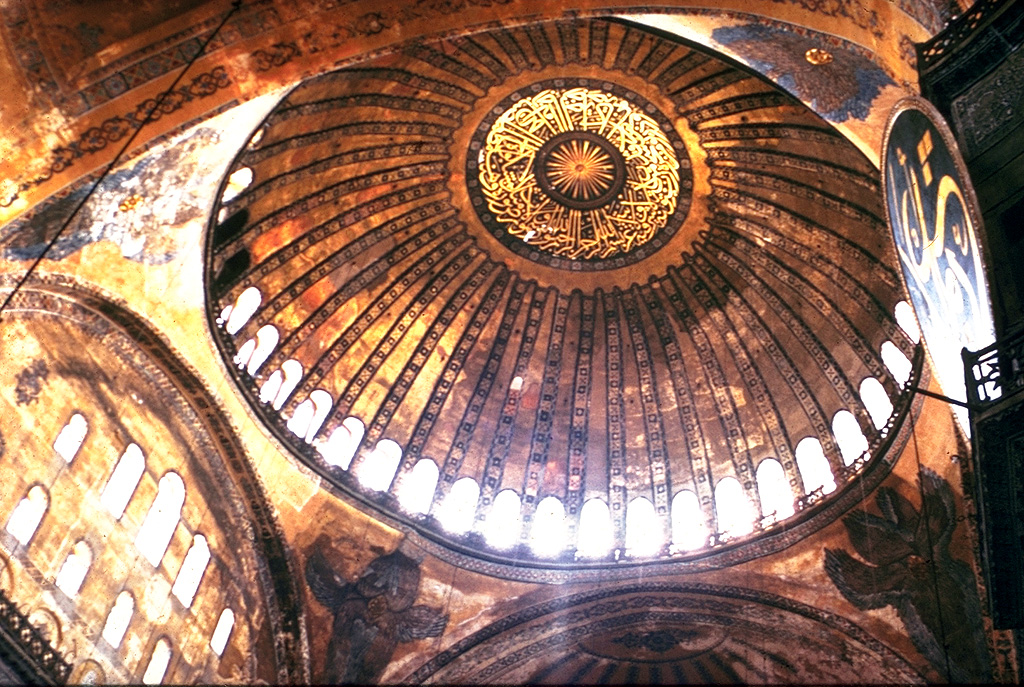
Reconstruction started just 39 days after the destruction of the original church. The gigantic structure was modeled loosely on the Roman Pantheon. Measuring 220 feet by 250 feet along its main floor, it was laid out as a rectangle, at whose center was a square. Soaring 180 feet above the square was a dome supported by four massive pendentives on equally massive piers. At the east and west ends of the dome square were two have domes serving as the apse and entrance bay. The engineering feat was even more incredible considering that only brick, mortar, and stone were used. Although the earlier Romans knew how to make concrete, these Eastern builders did not.

Justinian embellished the interior with riches. Four acres of gold mosaics shimmered from the ceiling, and multicolored marble gleamed from the floors, columns, and wall panels.

Less than six years after work on it began, Justinian's monument to Christendom was completed. In A.D. 558 much of it collapsed due to the many earthquakes in the region. Because the initial architects, Anthemius and Isodorus, were no longer living, the latter's nephew, Isidorus the Younger, was given the task of rebuilding. This time it lasted 400 more years before collapsing again, and being again rebuilt.

In 1204, knoghts of the Fourth Crusade marched on the Byzantine Empire's capital city, stripping it and Hagia Sophia so remorselessly that a chronicler called it the most awesome plunder "since the creation of the world."

When Rome's hegemony ended 57 years later, the Church of the Holy Wisdom was devoid of glittering wealth. Bulky buttresses were built to shore it up, but its days of glory, and those of Constantinople, were drawing to a close. In 1453, Sultan Mohammed II massed the Ottoman army in front of the city. After a 53-day siege, the Byzantine Empire's great capital capitulated, and the conqueror marched into town and directly to Hagia Sophia. His ulama recited a Muslim prayer, and the sultan declared Eastern Christianity's cornerstone a mosque.

For almost 500 years it remained such, its mosaics whitewashed to hide the "idolatrous" figures of humans. Koranic inscriptions were placed in the four corners beneath the dome; four minarets were erected at the corners of the exterior perimeter; a gilded bronze crescent replaced the large metal cross crowning the basilica.

While the changes offended Christians, the Mosque of Holy Wisdom enjoyed a place of high regard among devotees of Islam. In the 20th century, Turkish leader Kemal Ataturk viewed the structure as a unifying symbol for East and West. He closed the mosque in 1932, uncovered its medeival mosaics, and reopened Hagia Sophia as a museum in 1934. Nearly 15 centuries after Justinian, it stands as a monument to both human and divine wisdom.